ADVERTISEMENT
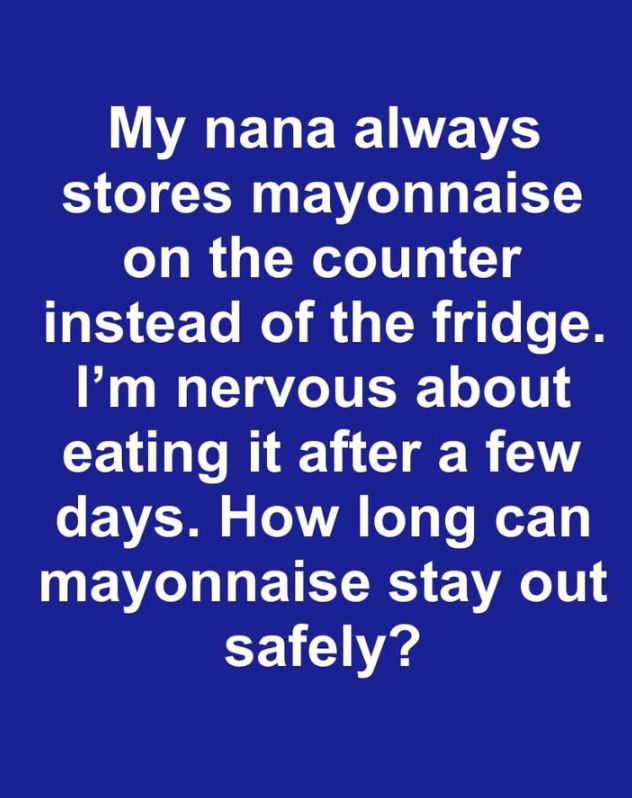
What most people don’t realize is that mayonnaise contains a powerful built-in defense mechanism.
Acidity.
Commercial mayonnaise is made using ingredients such as vinegar or lemon juice, creating an acidic environment that many harmful bacteria struggle to survive in.
ADVERTISEMENT
In fact, the pH level of mayonnaise is often low enough to significantly slow bacterial growth.
That’s one reason manufacturers can safely display unopened jars on grocery store shelves rather than in refrigerated sections.
Think about that for a moment.
If unopened mayonnaise were extremely dangerous at room temperature, supermarkets wouldn’t store thousands of jars that way every day.
Homemade vs. Store-Bought: A Huge Difference
This is where many people get confused.
Not all mayonnaise is created equal.
Homemade mayonnaise often contains raw eggs and lacks the preservatives used in commercial products.
As a result, it can spoil much more quickly.
Store-bought mayonnaise, on the other hand, typically contains pasteurized eggs and ingredients designed to improve stability and shelf life.
In other words:
The mayonnaise your grandmother made in her kitchen and the jar sitting in your refrigerator are not exactly the same thing.
And that distinction matters.
The Real Danger Isn’t Always the Mayo
Here’s something fascinating.
Researchers investigating foodborne illness outbreaks often discover that mayonnaise itself wasn’t responsible.
Instead, the problem came from the foods mixed with it.
Think about:
- Chicken salad
- Tuna salad
- Potato salad
- Egg salad
These foods contain ingredients that can support bacterial growth if left at unsafe temperatures for too long.
The mayonnaise gets blamed because it’s visible.
But sometimes the real culprit is hiding underneath.
Why Room Temperature Changes Everything
Bacteria love one thing above all else:
Opportunity.
When foods remain in the so-called “danger zone” between roughly 40°F and 140°F (4°C–60°C) for extended periods, bacteria can multiply rapidly.
That’s why food safety guidelines recommend limiting how long perishable foods remain unrefrigerated.
The issue isn’t necessarily the mayonnaise itself.
It’s the environment.
Warm temperatures create conditions where food safety risks increase dramatically.
The Psychology Behind Food Fears
Humans are naturally cautious about food.
And for good reason.
Throughout history, eating spoiled food could have serious consequences.
As a result, our brains evolved to treat uncertainty around food as a potential threat.
That’s why people often react strongly to foods containing eggs, dairy, or meat.
Even when the actual risk is lower than they imagine.
In many ways, fear around mayonnaise reflects a very old survival instinct.
So Does Mayonnaise Need Refrigeration?
The answer depends on the situation.
Unopened Store-Bought Mayonnaise
Generally safe to store in a cool pantry until opened.
Always follow the manufacturer’s instructions printed on the label.
Opened Store-Bought Mayonnaise
Refrigeration is recommended after opening to maintain quality, flavor, and freshness.
Homemade Mayonnaise
Should be refrigerated promptly and consumed within a relatively short period because it lacks the safeguards found in commercial products.
The Surprising Bottom Line
Most people have spent years believing mayonnaise is one of the most dangerous foods in the kitchen.
The reality is far less dramatic.
Commercial mayonnaise is specifically formulated to resist spoilage and bacterial growth better than many people realize.
However, once opened—and especially when mixed with other ingredients—proper refrigeration becomes important.
So the next time someone panics because a jar of mayonnaise sat on the table during lunch, remember:
The truth is a little more complicated than the myth.
And sometimes the foods we fear most aren’t nearly as risky as we think.
ADVERTISEMENT