

ADVERTISEMENT
At first, it seems ridiculously easy.
In fact, that’s exactly why so many people fail.
The question contains no complicated math.
ADVERTISEMENT
No advanced logic.
No hidden formulas.
Just a few short sentences.
Yet millions of people who encounter this viral riddle confidently give the wrong answer within seconds.
The reason is fascinating.
And it has very little to do with eggs.
The Riddle
Take a moment before reading further.
Here’s the challenge:
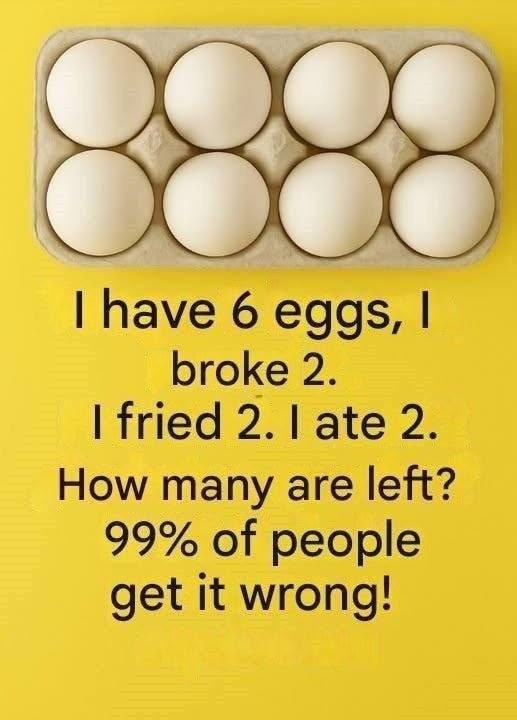
“I have 6 eggs. I broke 2. I fried 2. I ate 2. How many eggs do I have left?”
Simple, right?
Most people immediately blurt out an answer.
Some say zero.
Others say two.
A few insist it’s six.
And almost all of them arrive at their conclusion without fully realizing how their brain reached it.
That’s where the real puzzle begins.
Why Your Brain Wants to Rush
Human beings are wired for speed.
Every day, your brain processes enormous amounts of information.
To avoid becoming overwhelmed, it relies on shortcuts.
Psychologists often call these mental shortcuts heuristics.
Most of the time they’re incredibly useful.
They help you recognize faces instantly.
Understand conversations quickly.
Make decisions without analyzing every tiny detail.
But occasionally these shortcuts backfire.
And riddles like this are specifically designed to expose that weakness.
The Mistake Most People Make
When readers encounter the sequence:
- Broke 2 eggs
- Fried 2 eggs
- Ate 2 eggs
Their brains automatically imagine three separate actions involving three separate groups of eggs.
Without realizing it, they perform a calculation like this:
6 eggs
Minus 2 broken eggs
Minus 2 fried eggs
Minus 2 eaten eggs
Result:
0 eggs left.
The answer feels obvious.
The problem?
The riddle never says those were different eggs.
Not once.
Read It Again Carefully
Look closely at the wording.
“I have 6 eggs.”
“I broke 2.”
“I fried 2.”
“I ate 2.”
Notice what’s missing.
The riddle never states that the fried eggs were different from the broken eggs.
It never says the eaten eggs were different from the fried eggs.
That’s the trap.
Your brain fills in information that doesn’t actually exist.
The Hidden Assumption
To fry eggs, you normally break them first.
That means the most logical interpretation is that the same two eggs were involved throughout the entire sequence.
First:
You broke 2 eggs.
Then:
You fried those same 2 eggs.
Finally:
You ate those same 2 eggs.
Only two eggs were ever used.
The remaining four eggs were untouched.
Why This Feels So Wrong
Even after seeing the explanation, many people still resist it.
That’s because the brain dislikes discovering it made an assumption.
We naturally trust our first impressions.
When new information contradicts those impressions, discomfort appears.
Psychologists call this cognitive dissonance.
It’s the same feeling people experience when discovering they’ve misunderstood a situation, believed a rumor, or jumped to conclusions.
The egg riddle creates that feeling in miniature form.
And that’s exactly why it spreads so quickly online.
What the Puzzle Really Tests
Most people think this is a math problem.
It isn’t.
The arithmetic is easy.
The real challenge is reading comprehension.
Can you separate what is actually written from what your brain automatically adds?
That skill is surprisingly valuable.
Every day we’re surrounded by headlines, advertisements, social media posts, and conversations that encourage quick conclusions.
The people who pause and analyze carefully often avoid mistakes others never notice.
The Psychology Behind Viral Riddles
There’s a reason puzzles like this become internet sensations.
They trigger curiosity.
They create disagreement.
And they generate a powerful emotional reaction when people discover they’ve been fooled.
Researchers have found that surprising information is more likely to be shared than predictable information.
When someone realizes the answer isn’t what they expected, they immediately want to test friends and family.
The cycle repeats.
One person shares it.
Then another.
Then thousands more.
Before long, a simple egg question becomes a worldwide debate.
So What’s the Correct Answer?
See more on the next page to continue reading →
ADVERTISEMENT